CountIn Now Finds Beat One in 87% of Recordings, Up From 77%
· 5 min read
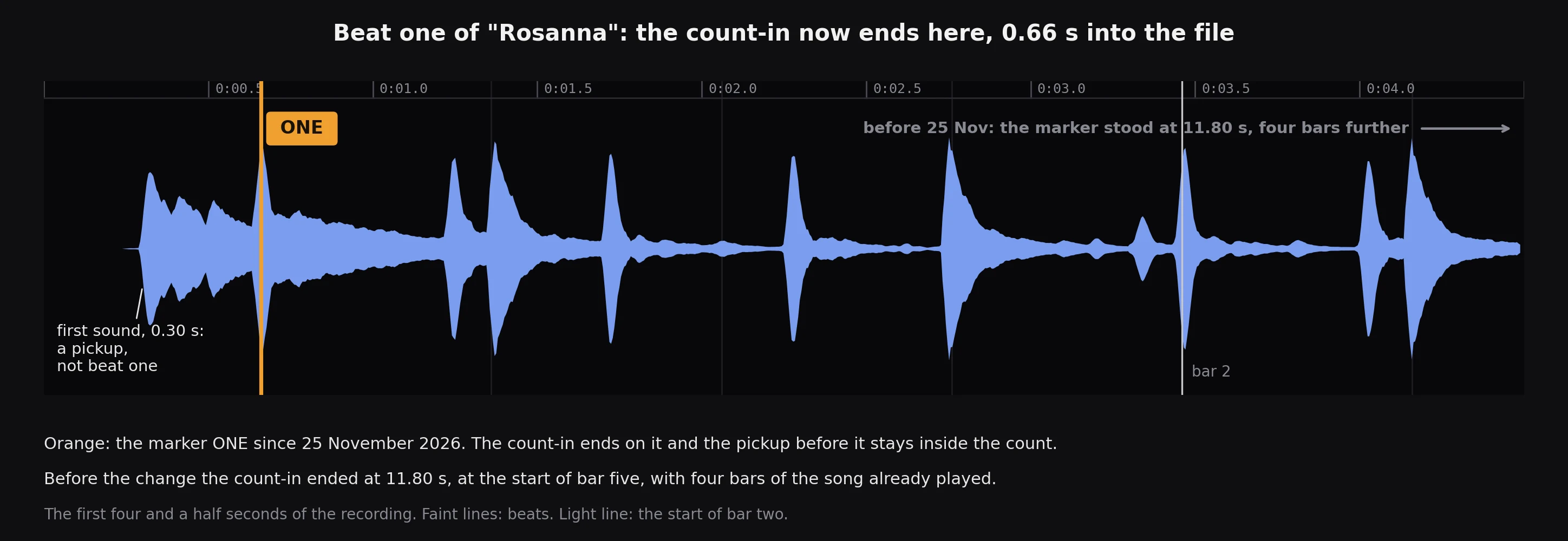
Beat one on a real recording: the first four and a half seconds of Rosanna by Toto, with the marker ONE where CountIn puts it since 25 November 2026.
Masataka Goto and Yoichi Muraoka of Waseda University presented A Beat Tracking System for Acoustic Signals of Music at the ACM Multimedia conference in 1994, and a later paper of theirs reported beats followed correctly in 42 of 44 commercially released pop songs. Eric Scheirer's Tempo and Beat Analysis of Acoustic Musical Signals appeared in The Journal of the Acoustical Society of America in January 1998. Both systems answered the question of where the beats are. Which of those beats is number one of the bar, the downbeat, is a second question, and a count-in depends on it: four clicks that end on beat three are four wrong clicks.
Florian Krebs, Sebastian Böck and Gerhard Widmer of Johannes Kepler University in Linz took up that second question in Rhythmic Pattern Modeling for Beat and Downbeat Tracking in Musical Audio at the ISMIR conference of 2013. The same three authors followed in 2016 with Joint Beat and Downbeat Tracking with Recurrent Neural Networks. In 2024 Francesco Foscarin, Jan Schlüter and Gerhard Widmer presented Beat This! at ISMIR in San Francisco, a tracker of beats and downbeats that drops the statistical post-processing step earlier systems relied on.
If the backing track is on your computer, hear CountIn count it in on beat one. Listening is free and needs no account.
The two questions
| Question | What it decides in a count-in | Typical error |
|---|---|---|
| Where are the beats? | the spacing of the clicks | half or double tempo |
| Which beat is number one? | the beat the count-in ends on | the count ends on beat two, three or four |
| Which bar is the first one? | the second at which the count-in starts | the count starts one or more bars into the song |
The third row is the one that changed. A marker can stand on a true beat one and still be in the wrong place for a count-in, because the song has been playing for a bar or more before it.
What changed on 25 November 2026
Until that day the orange marker ONE in CountIn could stand on a true beat one and still be late: one bar into the song, or four. Since 25 November 2026 the count-in starts with the music. The case that led to the change was a guitar song at 95 BPM, where beat one is at 0.74 seconds and the marker went to 3.25 seconds, exactly one bar later.
Before and after, in numbers
| Test set | What was counted | Before | After |
|---|---|---|---|
| More than 500 recordings with every bar marked by hand | count-in starts on the first beat one of the recording | 77.4% | 87.2% |
| The same recordings | marker on a beat one, any bar | 88.1% | 87.8% |
| 30 songs with beat one marked by ear | marker on the mark | 24 (80%) | 26 (87%) |
| 30 other songs, pop, rock, jazz and jingles | markers that moved | 4 |
In the large set the marker moved in about one recording in ten. Two recordings were lost: in one the marker now stands a bar before the first marked beat one, in the other 120 milliseconds ahead of it.
Four songs where the marker moved
| Song | Released | Marker before | Marker after | First sound in the file |
|---|---|---|---|---|
| Nirvana, Smells Like Teen Spirit | 10 September 1991, Nevermind | 3.24 s | 1.08 s | 1.04 s |
| Queen, We Will Rock You | 7 October 1977, News of the World | 9.46 s | 6.48 s | 6.48 s |
| Toto, Rosanna | 31 March 1982, Toto IV | 11.80 s | 0.66 s | 0.30 s |
| Led Zeppelin, Black Dog | 8 November 1971, Led Zeppelin IV | 7.73 s | 6.34 s | 6.34 s |
The times belong to the copies that were tested, the audio of the official uploads; another release of the same song can start at a different second. All four new positions were checked by ear on 25 November 2026. On We Will Rock You the old marker stood one bar into the stomps and claps that Queen overdubbed on the drum riser of Wessex Studios. On Rosanna it stood four bars into the half-time shuffle of Jeff Porcaro.
One song that still resists
On Black Dog the count-in is right, and the click drifts from the drums at about 13 seconds. The riff of John Paul Jones carries an extra beat at the end of the phrase while John Bonham plays straight through, an arrangement Jones described in Guitar World in December 1996.
Keith Shadwick, a biographer of Led Zeppelin, described the Black Dog riff as a pattern that "turns back on itself more than once". The recording also opens with guitars warming up and the tape coming up to speed, six seconds before the first bar.
The marker stays in the hands of the player in every case. It can be dragged along the waveform, and a marker that has been dragged is never moved by the program again. What the marker is and how it sounds is in what is a downbeat, and notes that come before it in pickup notes. The steps from a file to a finished count-in are in how to add a count-in to a backing track.
FAQ
How accurate is automatic detection of beat one?
On more than 500 recordings with every bar marked by hand, the count-in from CountIn starts on the first beat one in 87.2%. Before 25 November 2026 the figure was 77.4%.
Can the marker be set by hand?
Yes. The orange flag ONE is a handle. It moves along the waveform in the editor, and the count-in follows it.
Sources
- Masataka Goto, Yoichi Muraoka: A Beat Tracking System for Acoustic Signals of Music, ACM Multimedia 1994, pages 365 to 372; A Real-time Beat Tracking System for Audio Signals.
- Eric D. Scheirer: Tempo and beat analysis of acoustic musical signals, The Journal of the Acoustical Society of America 103(1), January 1998.
- Florian Krebs, Sebastian Böck, Gerhard Widmer: Rhythmic Pattern Modeling for Beat and Downbeat Tracking in Musical Audio, ISMIR 2013.
- Sebastian Böck, Florian Krebs, Gerhard Widmer: Joint Beat and Downbeat Tracking with Recurrent Neural Networks, ISMIR 2016.
- Francesco Foscarin, Jan Schlüter, Gerhard Widmer: Beat This! Accurate beat tracking without DBN postprocessing, ISMIR 2024.
- Wikipedia: Smells Like Teen Spirit, We Will Rock You, Rosanna (song), Black Dog (Led Zeppelin song).
- John Paul Jones on the Black Dog riff, Guitar World, December 1996.
If the backing track is on your computer, hear CountIn count it in on beat one. Listening is free and needs no account.
← Back to Blog · Click track · Free BPM finder · Tap tempo · Key changer